The Improv Comedy Musician: The Ultimate Guide to Playing Music with an Improv Group Learn musical improv from Laura Hall of “Whose Line Is It Anyway?”Are you a musician who performs with an improv comedy group? If so, this book is for you! You’ll also greatly benefit if you are a music director, improv team leader, improv teacher or coach, improv actor or singer, or just a hardcore Whose Line fan. This book is an opportunity for me to share knowledge gained from my years of improv experience. You’ll learn how I do what I do on Whose Line is it Anyway (plus get some insider stories about the show!) And you’ll get tips and pointers on how to play for live improv shows, play in different styles, accompany improvised songs, know how to approach long and short form, improvise musicals, be a valuable team player, and lots more.
english
Improv Nonsense: All The Posts This is a book about long-form improv, the art of making up comedy scenes as you go (meaning no script) on a stage. Improv Nonsense was a critically acclaimed blog about long-form improv, written by Will Hines, a teacher and performer from the Upright Citizens Brigade Theatre. The blog ranged from Will’s off-the-cuff musings like “New students sure do like to use the name ‘Janice’” to long, detailed essays like “Why are there fewer women then men on improv teams?.” It was sharp, opinionated, made no effort to include the newcomer, interesting, friendly, helpful and often completely wrong. Six years of posts, almost 600 pages of stuff. This book can be obtained in digital format for less than €10
This practical guide presents a wide array of games and exercises designed to develop the players observation, imagination, presentation and self-confidence. This long-awaited new edition has been fully revised and extended, now including example workshops and an index of games to help instructors get the most out of the exercises in rehearsals, workshops and classes. Christine Poulter shares what she has learned from her students over the years, and opens up the language of the book to the worlds of youth work, healthcare, the prison service, ‘customer care’, management training, and secondary school education. This is an essential resource for directors, drama teachers, and students of Drama, Theatre and Performance at all levels. It will also be useful to anyone looking to improve their presentation skills.
John Abbott, author of The Improvisation Book, explains how theatre directors at every level can use improvisation in the rehearsal room. Foreword by Mark Rylance. ‘Improvisation can be used as part of the creative process of rehearsing a play. It can be a fabulous tool for exploration and discovery. It can strengthen the actor’s commitment to their character. And it can create an environment of confidence and spontaneity.’ Packed with useful exercises and improvisation scenarios, and examples from a wide variety of plays, Improvisation in Rehearsal reveals how improvisation enriches and enlivens the creation of characters, back-stories, relationships, shared histories and emotional lives. The book also demonstrates how improvisation can be used as a powerful tool in the foundation of a strong company, and when searching for the hidden depths and dynamics in a scene. Building on his own experience as an actor, director and teacher, Abbott writes with clarity and an infectious enthusiasm which will motivate directors to try the techniques for themselves. As Mark Rylance says in his Foreword, this book ‘will inspire and delight its readers’.
The Uses of Drama : Acting As a Social and Educational Force: An Anthology Aristotle, Barrault, Brecht, Chambers, Laban, Mariwitz, Stanislavski… this book contains personal selection of writings on the theatre, ranging in time from Aristotle to Brook. Included are such aspects as drama as therapy, drama in education and the search for new drama.
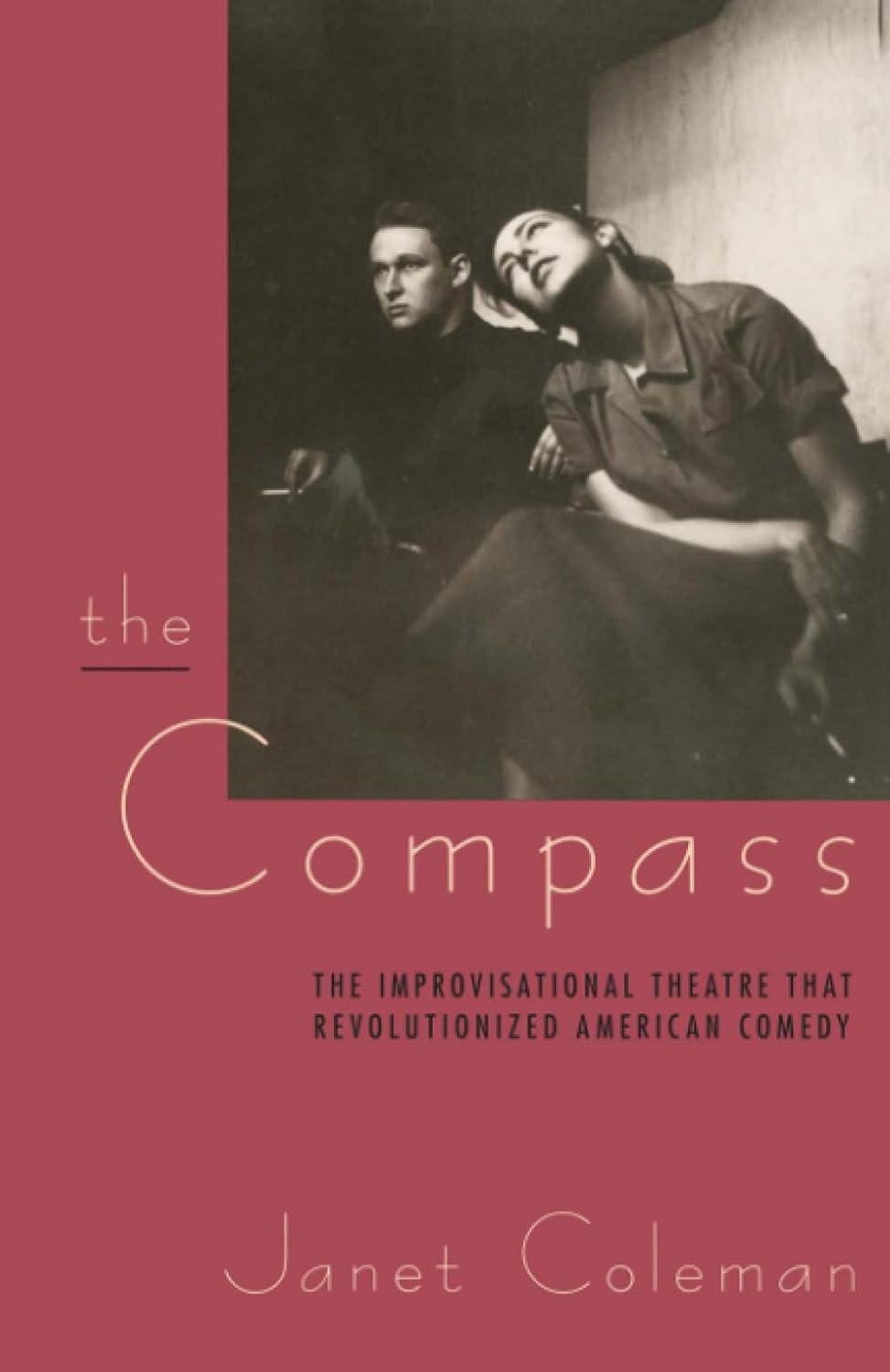
Janet Coleman brilliantly recreates the time, the place, the personalities, and the neurotic magic whereby the Compass made theater history in America. The Compass began in a storefront theater near the University of Chicago campus in the summer of 1955 and lasted only a few years before its players—including David Shepherd, Paul Sills, Elaine May, Mike Nichols, Barbara Harris, and Shelley Berman—moved on. Out of this group was born a new form: improvisational theater and a radically new kind of comedian. “They did not plan to be funny or to change the course of comedy,” writes Coleman. “But that is what happened.”
The Improvisation Game: Discovering the Secrets of Spontaneous Performance Packed with exercises and practical techniques, The Improvisation Game explores how improvisation can be used both to create performance and as an end in itself. It reveals the techniques, structures, and methods used by key practitioners in the field of improvised drama, music, and dance—among them are Keith Johnstone, Max Stafford-Clark, Phelim McDermott, Tim Etchells, John Wright, and Robert Lepage.
Training Using Drama: Successful Development Techniques from Theatre and Improvisation The use of training techniques originally developed for theatre and improvization within the workplace has increased enormously and the effectiveness of the approach is finding many enthusiastic followers. Sometimes actors themselves are brought into an organization to act as catalysts within a training/role-play setting, but increasingly, trainers use the techniques themselves. This guide to using development techniques from theatre and improvization shows how anyone can make use of them. Complete with 50 detailed activities, the book shows how to use storytelling, role-plays and coaching to improve creativity, leadership, teamwork and personal development.
Improvisation and Accompaniment for Social Justice How contemporary activists, artists, and academics oppose oppressive structures of power and unjust social relations to create a more decent and democratic future Insubordinate spaces are places of possibility, products of acts of accompaniment and improvisation that deepen capacities for democratic social change. Barbara Tomlinson and George Lipsitz’s Insubordinate Spaces explores the challenges facing people committed to social justice in an era when social institutions have increasingly been reconfigured to conform to the imperatives of a market society. In their book, the authors argue that education, the arts, and activism are key terrains of political and ideological conflict. They explore and analyze exemplary projects responding to current social justice issues and crises, from the Idle No More movement launched by Indigenous people in Canada to the performance art of Chingo Bling, Fandango convenings, the installation art of Ramiro Gomez, and the mass protests proclaiming “Black Lives Matter” in Ferguson, MO. Tomlinson and Lipsitz draw on key concepts from struggles to advance ideas about reciprocal recognition and co-creation as components in the construction of new egalitarian and democratic social relations, practices, and institutions. Insubordinate Spaces: Improvisation and Accompaniment for Social Justice is from the Insubordinate…
We’re at it again with a THIRD BOOK! We asked popular improv teachers and performers from around the world their advice. We felt like it was especially poingant to discuss improv in the times of Covid and Lockdown. We published all their beuaitulf answers on the improv community here! David Escobedo gathered and published this book. He has been coaching and performing improv since 1994, and who runs the Improv Boost.